


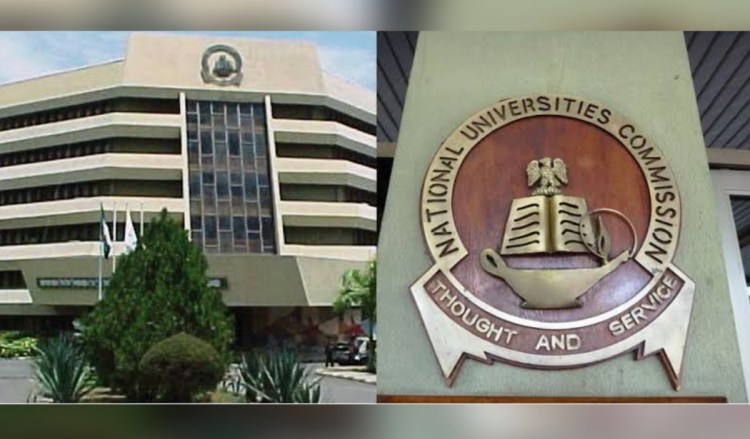
The National Universities Commission (NUC) has announced the launch of a nationwide recruitment exercise to fill vacancies at its headquarters in Abuja, News360 Nigeria reports.
In a public notice released on Friday, the Commission invited qualified Nigerians to apply for roles across officer, confidential secretary, clerical, and auxiliary staff cadres, stressing that the process is free and applications must be submitted via its official careers portal.
“The recruitment exercise is open to all eligible Nigerians who meet the advertised requirements.”
“Applications are free of charge and must be submitted through the official careers portal,” the notice stated.
Applicants are required to visit careers.nuc.edu.ng or nuc.edu.ng for detailed guidelines, with a six-week deadline for submissions. Only shortlisted candidates will be contacted for further screening.
For officer cadre positions, available roles include Senior Officer (CONTISS 9), Trainee/Officer I (CONTISS, and Trainee Officer II (CONTISS 7). Candidates for Senior Officer must hold a PhD or a Master’s degree with at least six years of post-qualification experience, while Trainee/Officer I requires either a Master’s degree or a first degree with three years of relevant experience.
Trainee Officer II applicants must possess at least a first degree in a related discipline.
Recruitment also covers Confidential Secretary I (CONTISS 7), for which candidates must hold a Higher National Diploma in Secretarial Studies and three years’ post-qualification experience.
Clerical and auxiliary vacancies include roles such as Assistant Cameraman, Data Processing Assistant, Artisan/Craftsman (carpenter, plumber, electrician, and air-conditioning mechanic), Lift Operator, and Motor Driver/Mechanic. Required qualifications range from a First School Leaving Certificate to an ‘O’ Level certificate with trade test credentials and relevant technical training.
Established in 1962 and given statutory powers in 1974, the NUC is responsible for accreditation, licensing of new universities, and ensuring quality standards across Nigeria’s 283 approved universities, including 72 federal, 67 state, and 168 private institutions.
